

IGLESIA DE SAN PEDRO Y SAN PABLO (ENG)
CHURCH OF SAN PEDRO AND SAN PABLO
EXHIBITION INFORMATION
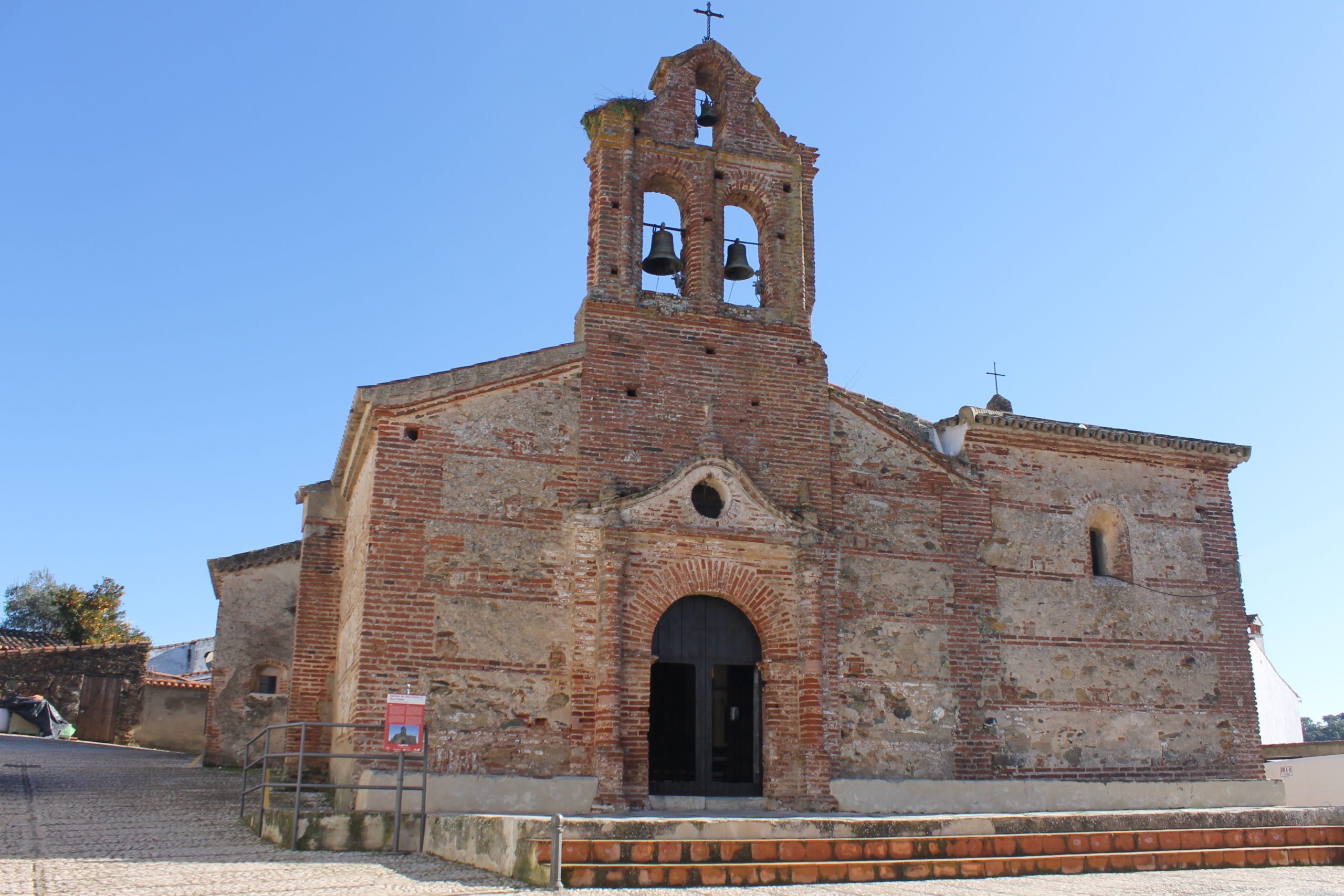
It is the main local religious and artistic building, declared by the Junta de Andalucía as a BIC (Bien Interés Cultural). It is located at the northern end of the village, in a small square. Its official building chronology is dated from the 14th-15th centuries, although some sources date it back a century. With a Latin cross, it is in the Gothic-Renaissance style on a Romanesque floor plan. It has a single nave divided into three sections with diaphragm arches.
The southern doorway is built as a three-level belfry tower, which is topped by a wrought-iron cross. The cover of the Epistle has a semicircular arch on two columns with a pedestal flanked by attached pilasters that protrude from the outside in a triangular shape. On the outside, we can see some buttresses that correspond to the extension of the diaphragm arches inside the building giving the whole a Romanesque style. Also in the outline, in the front south corner, the one of the »Capilla Bautismal», we can appreciate a sundial made of marble. It was placed at the beginning of the 18th century. An inscription reads: «Being a priest and a beneficiary /don Juan García Granado/ was made. The year was 1727’’.
The history of the Church of St. Peter and St. Paul begins with the Romans who settled in the Sierra in the valleys with streams. In the valleys of our Sierra that have these characteristics we find Roman vestiges like Santa Marina, San Mamés and the parish church of the municipality, among others.
In the Sierra there began to be a Christian population after the Reconquest, in the middle of the 13th century, and those who arrived were repopulating peasants from the North of Spain. These peasants must be offered places of worship, and this is where there were Roman sites, where it was easier for them to work their land and also more fertile, that is, on the plains near the streams.
The building we see now dates from the end of the 15th and beginning of the 16th centuries, coinciding in the Peninsula with the reign of the Catholic Monarchs, and is probably built on top of another primitive from the 13th century from the time of the repopulation.
At the end of the 16th century, the work was completed, and small minor interventions followed.
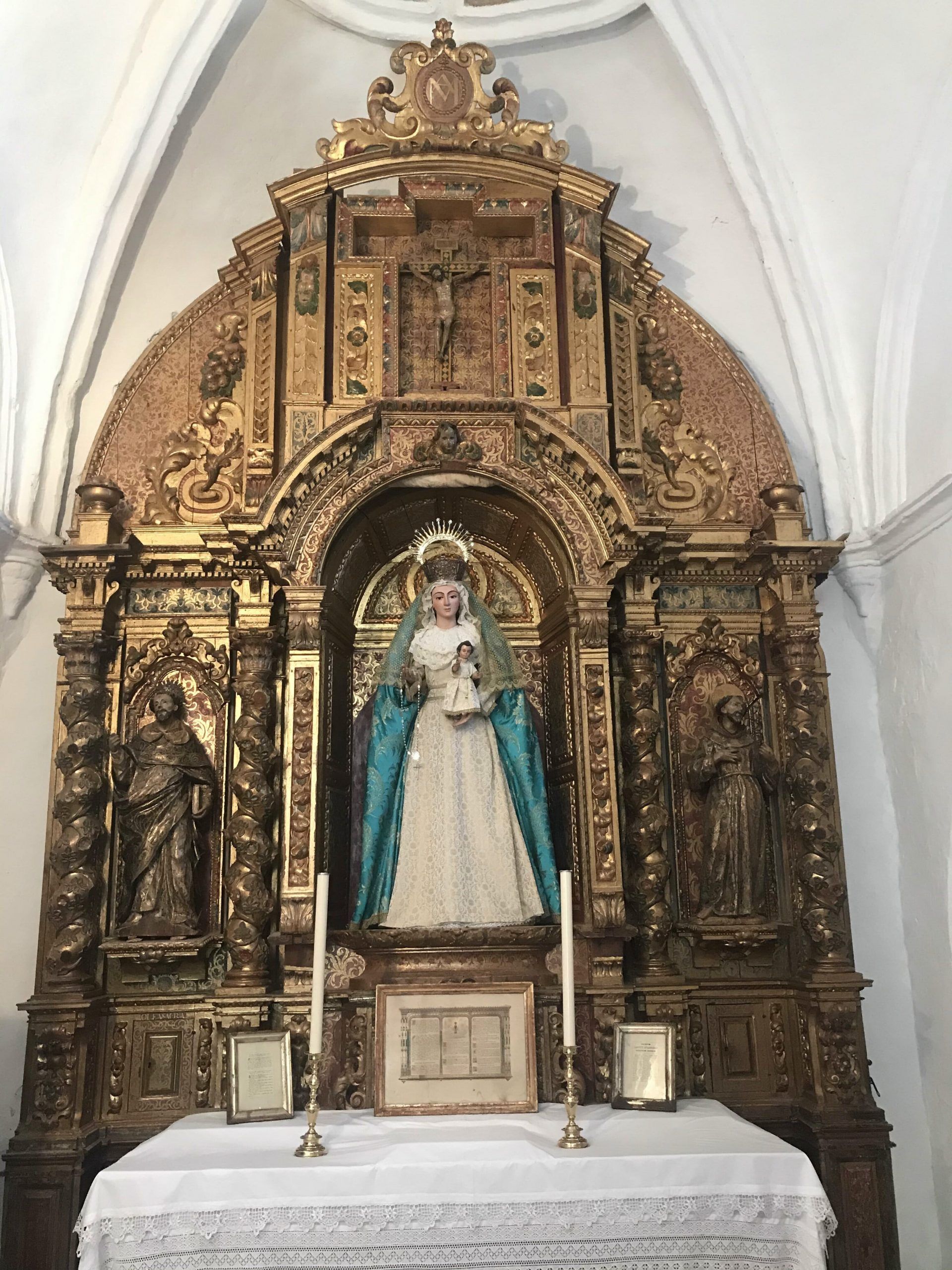
CHAPEL OF THE VIRGIN OF THE ROSARY
The altarpiece of the chapel of the presbytery (Chapel of the Virgin of the Rosary), whose information was found in Seville, of Solomonic order and oak wood, made and carved in Triana by the assembler and writer Miguel Franco in 1701.
The images of St. Francis and St. Dominic (founder of the Dominicans) and the Virgin of the Rosary, patron saint of the Dominicans dated in the 17th century and the baptismal font from the 16th century are represented.
ALTAR DE LA VIRGEN DE LA CABEZA
This is the most important altarpiece in the church. There is the sculptural image of the patron saint, the Virgen de la Cabeza, from the second half of the 15th century, with natural hair and which has the remains of another primitive medieval sculpture inside. Next door are the paintings of St. John the Baptist and St. Blaise.
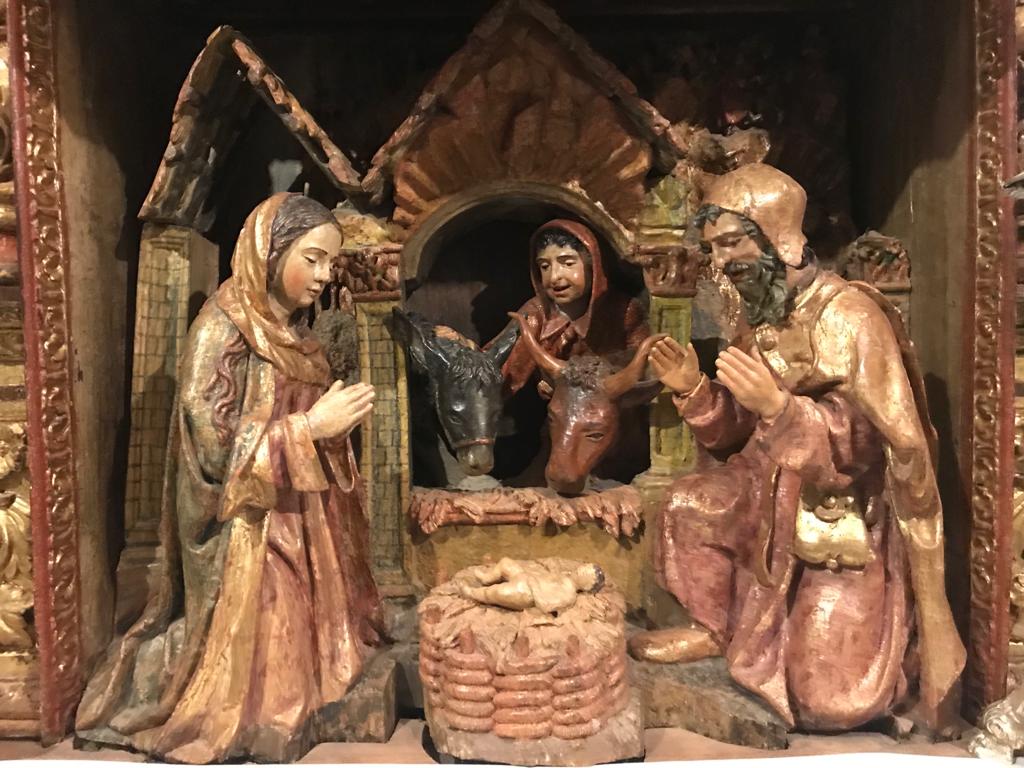
However, the highlight is the sculptural group of the nativity ‘The worship of the shepherds’, in polychrome golden wood with Solomonic columns, placed on the bench and linked to the circle of Jorge Fernandez Aleman. One of the few Franciscan nativity scenes in all of Europe.
This work must come from an altarpiece dating from the second quarter of the 16th century, similar to the style of the masters who worked on the main altarpiece of the cathedral of Seville. St. Joseph, the Virgin, the child, the mule, the ox and a franciscan are represented. In the side streets, the figures of San Joaquín and Santa Ana appear, superimposed on another previous ornamentation of leaves and scrolls, and on which two canvases of San Blas and San Juan Evangelista were placed. On the border we can see a Latin writing: «[EXCV]RGE DOMINE ET IVDICA CAVSAM [ME]AM«, «Arise, Lord, and judge my cause».
Its stylistic similarity with other altarpieces from the south of Badajoz and north of Huelva, allows us to think that it was carved in a workshop in Lower Extremadura around 1720.
The main alterations in the altarpiece were from the disappearance of certain parts of the material to the accumulation of dust and general deformations. Although of all of them, the ones that produced the most damage to the work were the repainting and the damage by termites, mainly in the central relief. This restoration has posed a major technical challenge since the state of conservation prior to the intervention could be considered almost total destruction.
The restoration of the altarpiece was carried out through different actions, from a superficial cleaning and elimination of calcinations to the volumetric integration of the lost pieces and chromatic reintegration of the areas where the reading of the whole was more altered. If we focus on ‘The Adoration of the Shepherds’, the restoration was carried out by means of individual treatment of each and every one of the pieces that make up the painting, due to the very high degree of deterioration that they suffered.
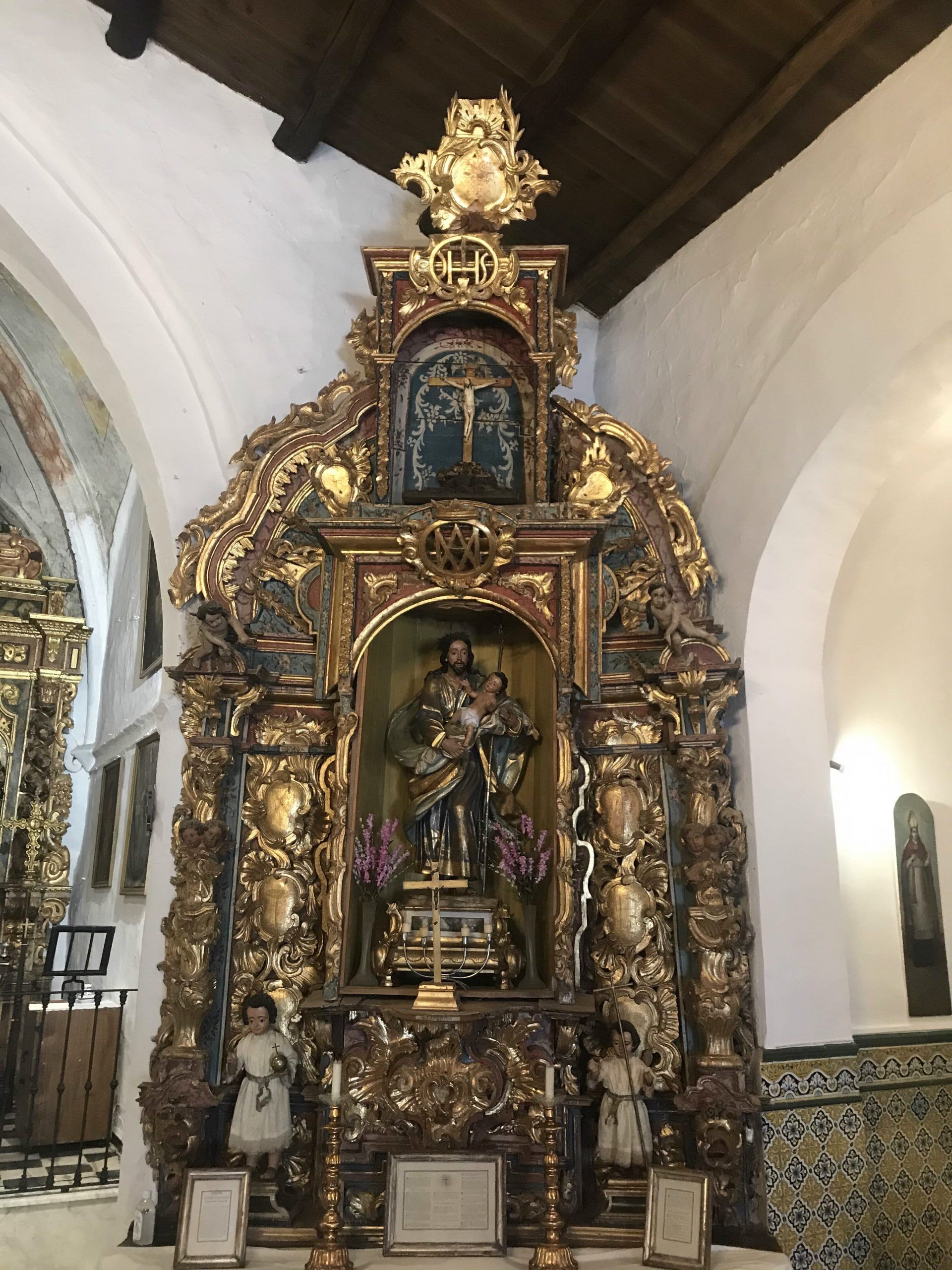
JOSEPH’S ALTAR – IVORY CHRIST
The altar of St. Joseph is composed of an altarpiece in which St. Joseph appears with the child, two Jesus children and two little angels as well as the Ivory Christ.
The Christ of Ivory is found at the top of the altar. The ivory crucifix came from the Philippines in 1805, sent by a merchant from Puerto Moral (José Antonio Ramirez Prieto), who worked for the Royal Company of the Philippines. The Christ is made of elephant tusk although the arms are coupled because the width of the tusk is not sufficient for the whole piece.
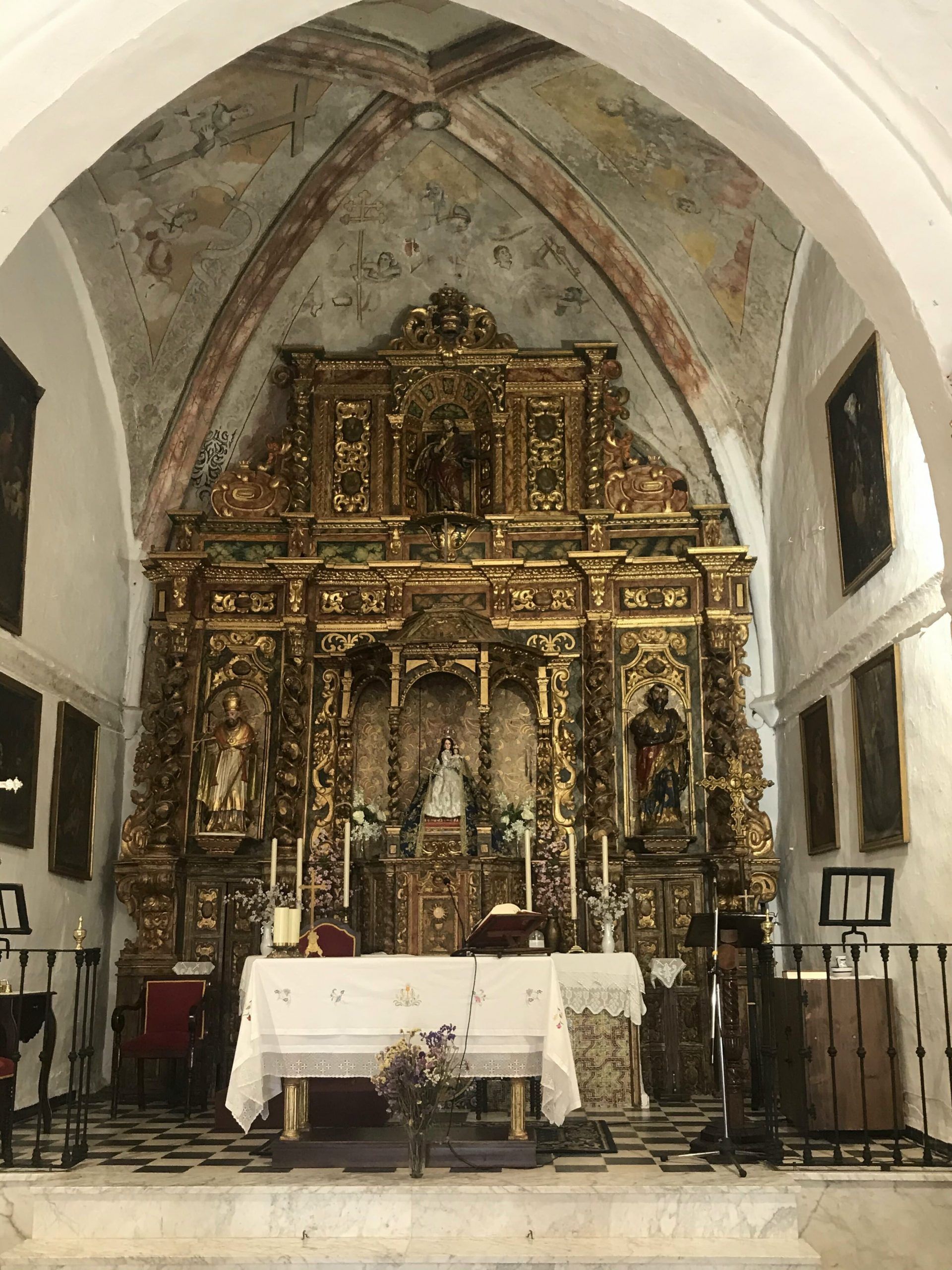
ALTAR MAYOR
The High Altar dates from 1701 and is composed of a bench where the tabernacle is placed and a central street with the image of El Salvador and those of St. Peter and St. Paul (patron saints of the village) on the sides. Of Solomonic order, it is decorated with columns of this style and with details of herringbone and vine.
This space is also decorated with a set of popular canvases, two from the 18th century representing the Virgin with the Child and the Adoration of the Shepherds and three from the 19th century, with the Presentation of Jesus in the temple, the Immaculate Conception and the Virgin with the napkin, a copy by Murillo.
CHAPEL OF THE VIRGIN OF THE GOOD END
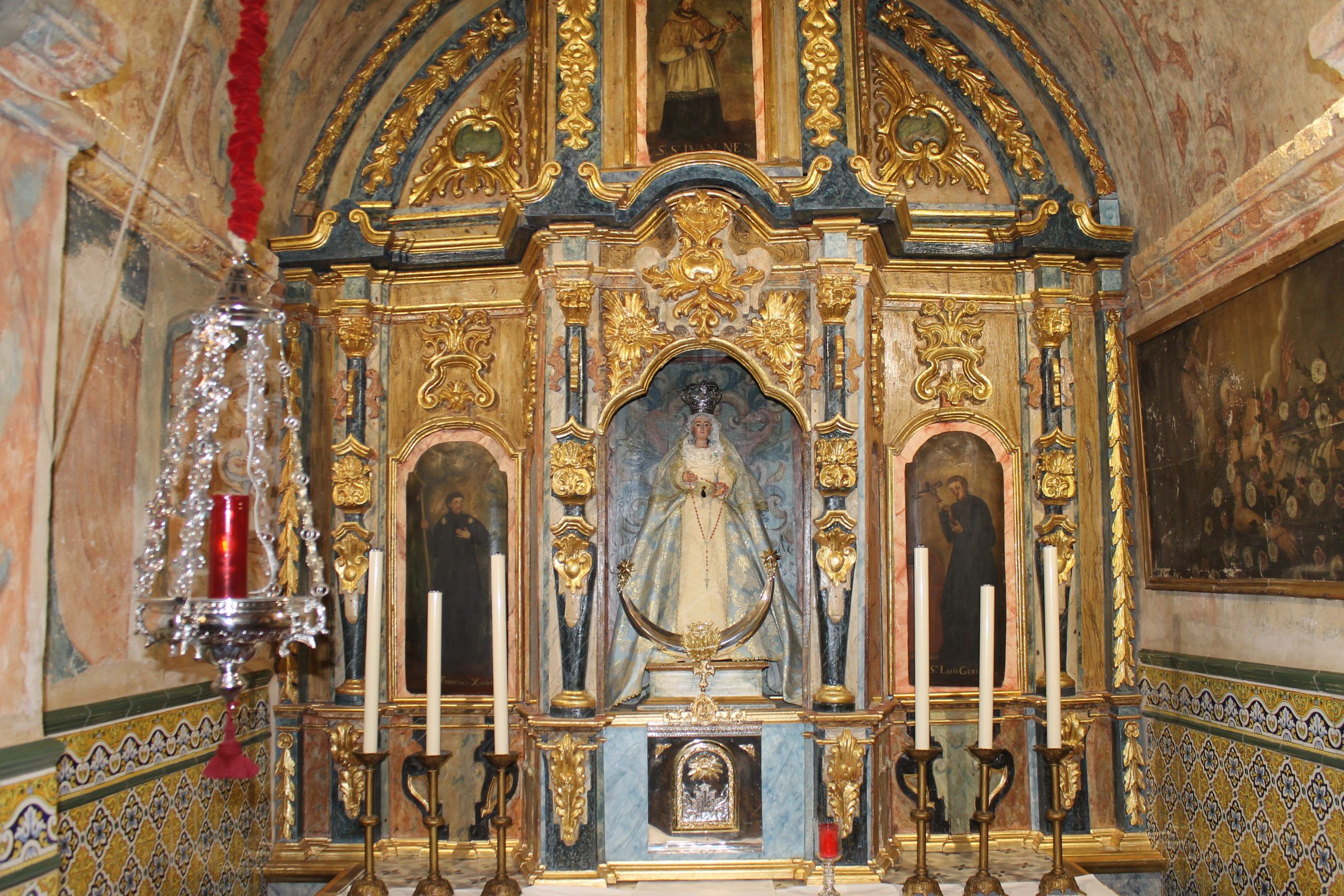
The Chapel of the Virgin of the Good End has an altarpiece made up of final elements from the 17th and 18th centuries. The title image is of clothing, from the end of the 18th century. To his left and right, there are paintings on boards, representing St. Francis Xavier and St. Louis Gonzaga and, in the attic, another of St. John of Nepomuk.
All of them have a popular character and can be dated, just like the tabernacle, in the last third of the 17th century. Also part of the decoration of this chapel is a canvas representing The Death of Saint Francis, from the 18th century, of popular dyes. The history of this altarpiece tells that some ancestors of Rincón Cañizares, after being in danger at sea, entrusted themselves to the Virgin of the Good End and that was the reason for their salvation.
ALTAR DEL CRISTO DEL PAPELÓN
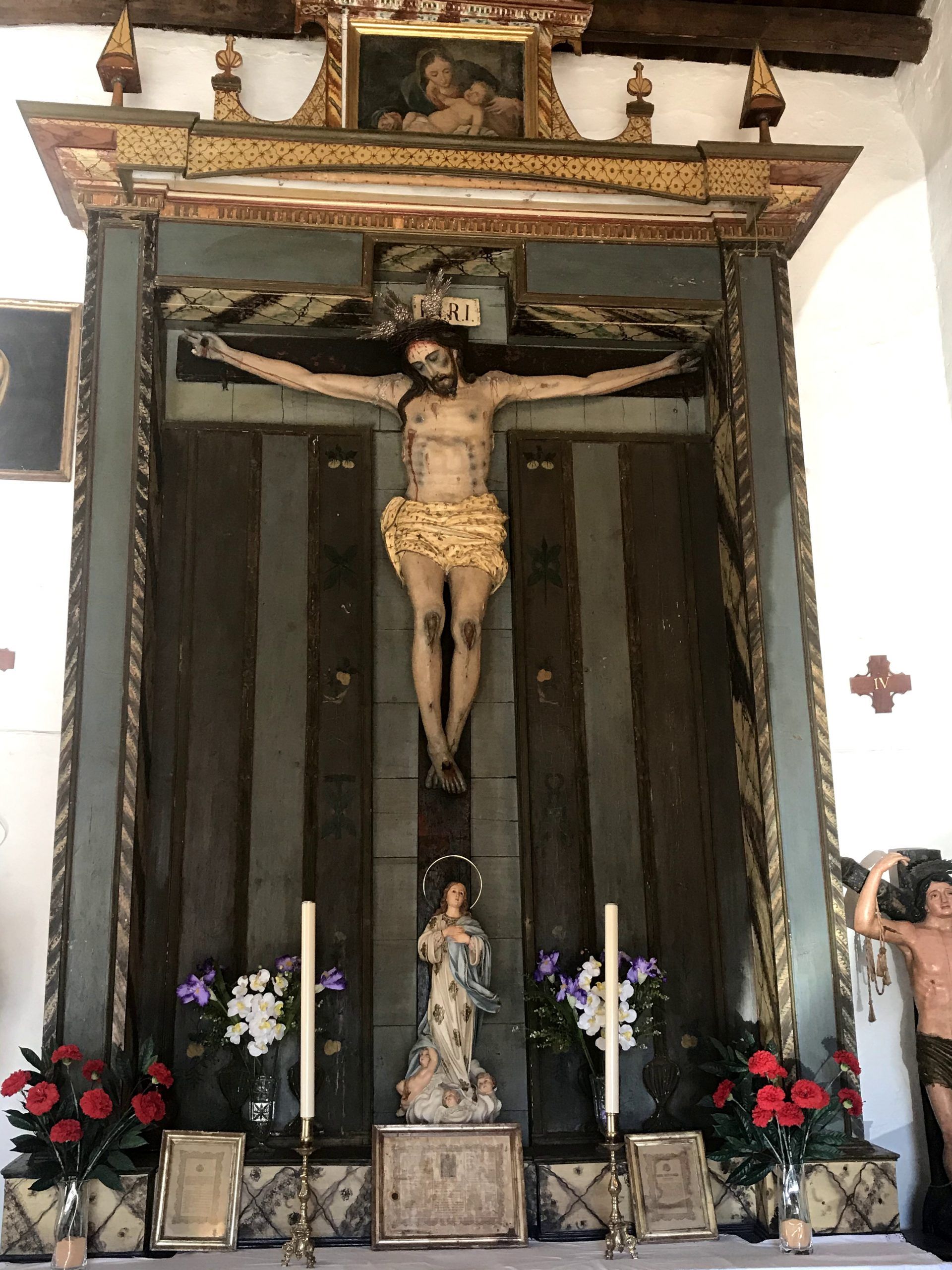
The crucifix made of papelón (paper pulp), with its silver powers, dates from the 18th century. To the left and right, respectively, are San Antonio de Padua and San Sebastián, both from the same period. In the attic there is a canvas of the Virgin with the child, from the 19th century.
This image is very common in the 16th century, because the Way of the Cross began with them. The first one in the area was presided over by the Duke of Medinaceli on his pilgrimage to Jerusalem.
RETABLE OF ANIMES – CHRIST TRIUMPHANT IN THE DEATH
The altarpiece of Animas of Puerto Moral is attributed to the workshop of the Chamber Painter Alonso Miguel de Tovar, before its transfer to the court in Madrid. Located on the right side of the parish, as established by the rules, the Christ Triumphant in the Face of Death is represented on this canvas. It dates from around the 18th century, although with modifications in the second half of that century as the archbishopric ordered some areas of the body of the souls represented to be covered.
More information:
Tourism Area – Ayto. Puerto Moral
959 12 00 89